Individual Agency and Musical Networks in Nineteenth- and Twentieth-Century Music History and Music Historiography
An International Conference in Honor of Tibor Tallián’s 80th Birthday
3–4 December 2026
Budapest, Institute for Musicology of the Research Centre for the Humanities ELTE
Conveners
Katalin Kim (Institute for Musicology of the Research Centre for the Humanities ELTE, Budapest)
Tatjana Marković (IMS SG Music and Cultural Studies; Austrian Academy of Sciences, Vienna)
About
On 3–4 December 2026, an interdisciplinary international conference will be held in honour of Tibor Tallián, Member of the Hungarian Academy of Sciences, former Director and Professor Emeritus of the Institute for Musicology, and Professor Emeritus of the Liszt Ferenc Academy of Music. As a scholar, teacher, institutional leader, and one of Hungary’s most influential music critics, Tallián has played a defining role in shaping Hungarian musicology for more than five decades. His scholarly achievements, his distinctive literary approach to music criticism, and his commitment to making musical culture accessible to wider audiences have left a lasting mark on both academic research and Hungarian musical life.
The conference will be held in person, but the presentations will also be broadcast live via Zoom by the Institute of Musicology and will be made available on the Institute's website at a later date. To watch the live broadcast, click on the links in the program a few minutes before the event begins.
Useful information
Information on public transport, tickets, restaurants
The venue of the conference
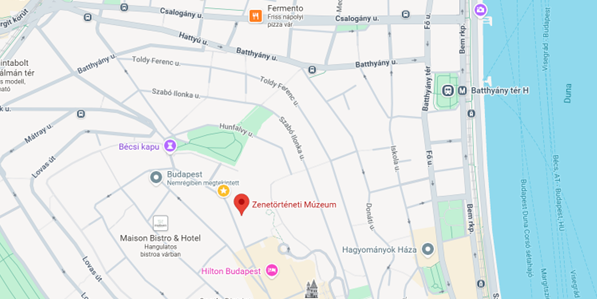
ELTE HTK Zenetudományi Intézet / Zenetörténeti Múzeum
Budapest, Táncsics Mihály u. 7, 1014
Bartók Hall and Haydn Hall
Public transportation
Public transportation is well-organized and reliable in Budapest. Google Maps is practical and also reliable for planning routes.
The conference venue is most easily reached by buses 16, 16A, and 216.
Approaching from Széll Kálmán tér, take buses 16 or 16A and get off at Bécsi kapu tér.
Approaching from Deák Ferenc tér, bus 16 is recommended; get off at Szentháromság tér or Bécsi kapu tér.
Bus 216 turns toward the Buda Palace buildings, so if you take this line, it is best to get off at Schulek Frigyes lépcső. From there, going up the stairs will take you to the Fisherman’s Bastion (Szentháromság tér) in either direction.
If you prefer to avoid stairs or longer walks, bus 16 (or 16A from Széll Kálmán tér) is recommended.
Tickets for Public transport
Tickets can be purchased from ticket machines troughout the city or through the BudapestGo mobile application. The app is more practical, as unused tickets can be refunded and the cost is reimbursed immediately.
Call for Papers
Call for Papers
On 3–4 December 2026, an interdisciplinary international conference will be held in honour of Tibor Tallián, Member of the Hungarian Academy of Sciences, former Director and Professor Emeritus of the Institute for Musicology, and Professor Emeritus of the Liszt Ferenc Academy of Music. As a scholar, teacher, institutional leader, and one of Hungary’s most influential music critics, Tallián has played a defining role in shaping Hungarian musicology for more than five decades. His scholarly achievements, his distinctive literary approach to music criticism, and his commitment to making musical culture accessible to wider audiences have left a lasting mark on both academic research and Hungarian musical life.
Inspired by the breadth of Tallián’s scholarship and his exemplary career, the conference explores not only the interplay between individual actors, their professional, artistic, and institutional networks, and broader institutional structures in shaping musical culture and its historiography, but also the significance of personal responsibility and social engagement at all levels of cultural life.
Building on these concerns, the conference draws on Tallián’s principal fields of scholarship as points of departure for broader methodological and historiographical questions concerning individual agency, networks, and institutions. Among these fields are nineteenth-century Hungarian opera, from the emergence of professional operatic performance at the Pest National Theatre to the establishment of the Hungarian Royal Opera House; the work of Ferenc Erkel as composer, conductor, and institution builder, alongside the internationally acclaimed prima donna Rosalia Schodel, set within the broader European operatic landscape, as well as the transfer of contemporary international repertoire to Hungary. Equally significant are Tallián’s studies of twentieth-century Hungarian music, encompassing landmark source editions on composers and musical institutions, his authoritative biography of Béla Bartók, his widely acclaimed monographs on Bartók’s American years and Cantata profana, as well as his numerous studies on Béla Bartók and Zoltán Kodály. Most recently, this body of scholarship has been expanded with the landmark critical edition of Zoltán Kodály’s unpublished notes (selected and edited by Tibor Tallián, in collaboration with Csilla Mária Pintér), opening up a new corpus of primary sources for future research.
Examining individual responsibility and musical networks through the lens of everyday musical practices offers a more fine-grained understanding of the actions and decisions of historical actors. In turn, this perspective invites a reconsideration of cultural memory and of the narratives through which the history of music has been constructed and transmitted.
We invite papers engaging with (but not limited to) the following themes:
1. The institutionalisation of opera and operatic life in the nineteenth and twentieth centuries: composers, performers, and other actors (including impresarios, administrators, copyists, and other participants in the everyday functioning of opera institutions), together with their professional and institutional networks and the institutional practices that shaped operatic life. Contributions adopting actor-centred, relational, and practice-oriented approaches to the study of musical life are particularly welcome.
2. Comparative analyses of nineteenth- and twentieth-century music criticism through the work of individual critics: methodological challenges in interpreting historical music criticism, particularly concerning the reception of new repertoire and the description and evaluation of performers’ styles. Thematic focus includes discourse analysis, source-critical approaches, the historical semantics of music-critical language, and contextual approaches to the interpretation of historical music criticism.
3. Music and politics in nineteenth- and twentieth-century musical life and music historiography: examined from the perspectives of source criticism (archival sources and ego-documents), reception history, and hermeneutic approaches centred on authorial intention.
4. Bartók, Kodály, and their contemporaries: social engagement and multiple roles as composers, performers, scholars, teachers, and institution builders, as well as their broader impact and historical legacy as musical actors and cultural figures. Thematic focus includes their positioning within twentieth-century musical life, the formation of their cultural roles, and the historiographical construction of their reception, canonisation, and intellectual heritage.
Submission
The conference languages are English and German. Abstracts (maximum 200 words) in either English or German, together with a short biography, should be sent by 30 September to the organisers at Ez az e-mail-cím a szpemrobotok elleni védelem alatt áll. Megtekintéséhez engedélyeznie kell a JavaScript használatát. and/or Ez az e-mail-cím a szpemrobotok elleni védelem alatt áll. Megtekintéséhez engedélyeznie kell a JavaScript használatát..
Programme Committee
Tatjana Marković, Austrian Academy of Sciences, Vienna
Katalin Kim, Institute for Musicology of the Research Centre for the Humanities ELTE, Budapest
Pál Richter, Institute for Musicology of the Research Center for the Humanities ELTE, Budapest
Alexandros Charkiolakis, The Friends of Music Society, Athens
Zdravko Blažeković, Executive Director of RILM, City University Graduate Center, New York
Leon Stefanija, University of Ljubljana
Rūta Stanevičiūtė, Lithuanian Academy of Music and Theatre, Vilnius
Lenka Krupková, Palacký University Olomouc
Venue
Institute for Musicology of the Research Centre for the Humanities ELTE, Budapest